
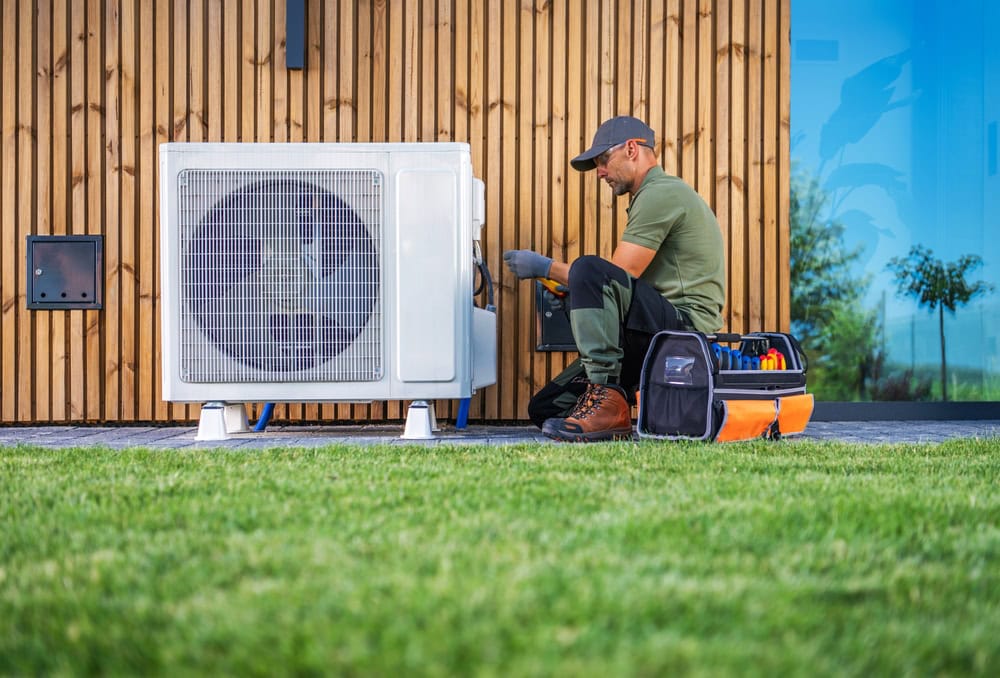
California’s HVAC contractors are noticing a lot of overlap between heat pump work and solar installations, and many are asking whether picking up an additional license is worth the investment. The short answer is that it depends heavily on the type of work you want to pursue, but understanding the rules first will save you from a costly licensing mistake.
Why HVAC and Solar Keep Intersecting
Heat pump systems, which are increasingly common in California retrofits, often get paired with solar panel systems to offset the added electrical load. A homeowner installing a heat pump HVAC system will frequently ask the same contractor about solar, since the two projects are related in the customer’s mind, even though CSLB treats them as separate trades.
This creates a natural business opportunity, but it also creates confusion about what a C-20 (Warm-Air Heating, Ventilating, and Air-Conditioning) license actually permits. A C-20 license covers the installation, repair, and replacement of HVAC systems and associated ductwork; it does not extend into solar photovoltaic or solar thermal work, regardless of how connected the two systems appear on a job site.
What the C-46 Classification Actually Covers
The C-46 Solar Contractor classification was adopted by CSLB in 1983 and is defined under California Code of Regulations, Title 16, Section 832.46 as covering the installation, modification, maintenance, and repair of thermal and photovoltaic solar energy systems. Importantly, a C-46 licensee is restricted from performing general building trades except when that work is directly required to install a solar system, meaning it is a narrow classification by design.
This narrowness is a common misconception among new contractors. Many assume that holding a C-46 gives them broad authority over anything solar-adjacent, including panel upgrades or new electrical subpanels. In reality, if a solar installation requires an electrical panel upgrade or new subpanel beyond what is incidental to the solar system itself, that portion of the work requires a C-10 (Electrical Contractor) license, and a C-46 alone will not cover it.
It is also worth knowing that C-46 is not the only path into solar work. California Business and Professions Code recognizes that Class A (General Engineering), Class B (General Building, when combined with another trade), C-10 (Electrical), C-4 (Boiler and Hot Water), C-36 (Plumbing), and C-53 (Swimming Pool) contractors can all perform certain solar-related tasks within the boundaries of their existing classifications. For an HVAC contractor, this means solar involvement does not automatically require a brand new license; it depends on exactly which piece of the solar puzzle you intend to touch.
Weighing the Real Cost Against the Opportunity
Adding a C-46 classification is not simply a paperwork exercise. Applicants need at least four years of documented journey-level experience in solar installation, repair, or maintenance within the ten years before filing, along with passing both the trade exam and the business and law exam if that exam has not already been waived through prior licensing history. For an HVAC contractor who has spent their career in ductwork and refrigerant lines rather than photovoltaic systems, meeting that experience requirement honestly can take real time, not a quick weekend course.
There is also a bonding and financial component: C-46 licensees carry the standard CSLB contractor bond obligations along with renewal fees every two years, similar to other specialty classifications. Before pursuing this path, it makes sense to ask whether the actual demand in your service area justifies the time spent gaining qualifying experience, versus simply partnering with an established C-10 or C-46 contractor on jobs that require both trades.
Making the Decision That Fits Your Business
The CSLB’s classification system exists to protect consumers from contractors working outside their proven expertise, not to make life difficult for HVAC professionals chasing new revenue. If your business genuinely wants to install and maintain photovoltaic or thermal solar systems as a core service, and you can document the required experience, pursuing a C-46 is a legitimate long-term investment. If your interest in solar is really about capturing HVAC customers who also want panels, a referral or subcontracting relationship with a licensed C-10 or C-46 contractor may serve your business goals without the added licensing burden.
The main takeaway for anyone studying for their license or considering an additional classification is this: California licensing law draws firm lines between trades, even when the physical work overlaps on a job site. Understanding exactly what your current classification allows, and what it does not, is the first step toward making a smart decision about expanding into solar.